

How to Price a Home to Sell: Real Estate Listing Coaching on $25K Jumps
Here’s how to price a home to sell: land on round numbers buyers search, usually $25K steps, so the listing shows up in two search bands.
How to price a home to sell comes down to one rule: price it on a round number buyers actually type into a search, usually in $25,000 increments, not on an odd number that matches your opinion of value. That is the heart of good real estate listing coaching on pricing. A listing with no activity is almost never a bad home. It is usually a beautiful home wearing a price tag no buyer will ever search for.
On my Monday coaching call, an agent brought me a listing that should be moving and is not. A fully renovated studio co-op, new bath, updated kitchen, new floors, a gorgeous city view. Listed at $215,000, dropped to $205,000, and nothing came back. No showings. No saves. No calls. “I don’t know what else to do,” she told me. I have heard that sentence a thousand times, and the answer is almost always the same.
Why Your Listing Gets No Showings, and How to Price a Home to Sell Instead
Before you touch anything else, you have to understand how buyers search, because knowing how to price a home to sell starts there, and that is where most listings quietly die. According to the National Association of REALTORS®, more than half of buyers find their home online, and every one of them starts with a price filter. Here is what I walked the agent through, and it is the core of the real estate listing coaching I do every week.
- Nobody searches odd numbers. A buyer does not type $205,000 into a portal. They type round numbers in roughly $25,000 increments. Show me everything from $175,000 to $200,000. Show me $200,000 to $225,000. That is how human beings shop for anything with a price, and homes are no exception.
- An odd number falls out of one search and looks weak in the other. At $205,000, the buyer searching up to $200,000 never sees the home. The buyer searching $200,000 to $225,000 sees it sitting at the bottom of the band, looking like the cheap option among nicer numbers. You lost one whole audience and looked weak to the other, for five thousand dollars.
- The right number works twice. At $200,000, that same home shows up as the strong value at the top of the $175,000 to $200,000 search, and as the affordable entry in the $200,000 to $225,000 search. One round number, two searches, instead of one odd number and silence.
- The increments widen as price climbs. In the low hundreds, think $25,000 steps. Higher up, buyers search in $50,000 steps, then larger. The rule never changes. Land on a number a real person would type. (This is also why I like to offer a price range at the listing appointment and let the seller help choose the band.)
- The data is talking if you measure it. If your listing gets fewer saves than comparable active homes, the market is telling you something about your photos, description, or price. That is real estate success in miniature: listening to what the numbers say instead of defending your first guess.
Once you see pricing as a search problem instead of a worth problem, the whole conversation changes. And it changes most for your seller.
How to Price a Home to Sell Without Saying “Lower the Price”
I want you to retire the phrase “lower the price.” It frames everything as a loss, for you and for the seller. What we are really doing is proper pricing, which means pricing to how people search so the right buyers can find the home at all. “Lowering the price” sounds like surrender. “Proper pricing” sounds like strategy, because it is. (For the full script, see my guide to the price adjustment conversation.)
How Many Price Reductions Can a Listing Survive?
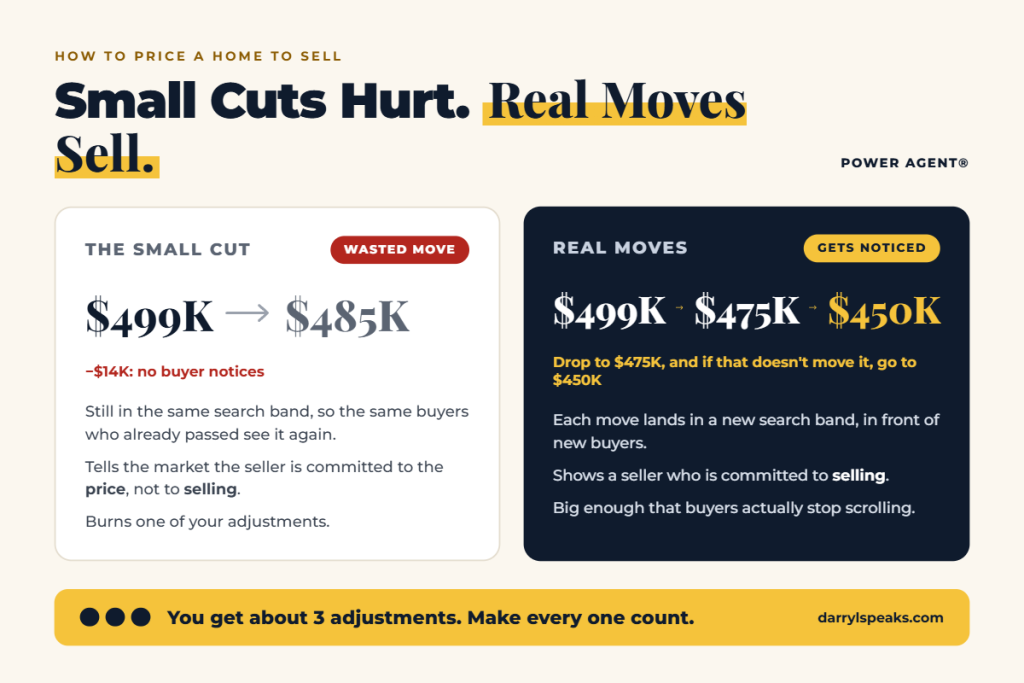
Knowing how to price a home to sell also means protecting your adjustments. You get about three real price moves before the listing history tells the market the home is desperate or defective. So make each one count. A home at $499,000 that drops to $485,000 has wasted a move, because no buyer sees fourteen thousand dollars and changes their mind. Worse, a token trim signals that the seller is committed to the price, not committed to selling. Someone committed to selling goes from $499,000 to $475,000, and if that does not move it, the next move is $450,000. Do not touch the price until you are ready to make a real one.
The Confidence Conversation That Makes It Land
The conversation that makes this land is a confidence conversation, not a discount conversation. It belongs on the short list of conversations every agent needs to master. Here is how I coach it. “When we came out at our first number, we both believed it was right. The market did not agree. That tells us neither of us knows yet what a buyer will pay. So let’s send up a flare gun to the market. Let’s price this where buyers are searching, let them come look, and let them tell us what it is worth.” And when the seller worries about giving money away, you tell the truth: “If this home is really worth more, we will negotiate up, and we may get multiple offers that push the price back up. With me, you will never sell your home for less than it is worth.”
Scripts like this one, and the bigger skill of knowing how to price a home to sell, are what we build inside the POWER AGENT® Program, alongside the Listing Report Card tool that lines your listing up against its true competition on days on market, saves, and views. You can hear how it works in the Listing Report Card episode of the POWER AGENT® Blogcast. For more on handling tough pricing talks, read my Inman column on price adjustments.
Powerfact: You are not pricing for what the home is worth. You are pricing for how buyers type.
How to Price a Home to Sell: Frequently Asked Questions
How should I price a home so buyers actually find it? Price it on a round number buyers actually search, usually in $25,000 increments. Odd numbers like $205,000 or $499,000 fall between search bands, so the right buyers never see the listing. Land on the clean number at the top of a band, where your home shows up and looks like value.
What does “proper pricing” mean in real estate listing coaching? Proper pricing means pricing to how buyers search rather than to your opinion of value. It is not lowering the price, it is making the home findable. The reframe turns a conversation that sounds like a loss into one that sounds like strategy, which is exactly what it is.
How many price adjustments should I make? About three before the listing history starts working against you. After three visible drops, buyers read the home as desperate. So make each adjustment a real move, not a token trim. A WOW drop gets attention. A small trim just burns one of your three chances.
Why are small price drops a mistake? Because no buyer notices them. Dropping $499,000 to $485,000 is invisible, and it signals that the seller is committed to the price instead of committed to selling. A meaningful drop, from $499,000 to $475,000 or $450,000, actually changes which buyers find and consider the home.
What if the seller refuses to price correctly? Have the confidence conversation. Explain that the first number was a shared guess the market rejected, and that pricing to the search is how you discover the true value through real buyer demand. If a seller still insists on a number no buyer will search, you are not in control of the listing, and that is a different conversation.
Does pricing strategy change in a slower market? It becomes more important, not less. In a shifting market you cannot afford to be invisible, so getting found through proper pricing is the whole game, and so is keeping the home in front of every buyer, which is why listing on the open market matters. I broke down what falling prices mean for agents in HousingWire, and the National Association of REALTORS® tracks how buyers search each year.
Want more scripts, strategies, and coaching? The POWER AGENT® Program has everything you need in one place!
Darryl Davis, CSP, is a national speaker, real estate coach, and the bestselling author of How to Become a Power Agent® in Real Estate. Learn more at darrylspeaks.com.

Get the latest real estate training tips delivered to your inbox!
POWER AGENTS®, your new Classroom is ready!
Search all 1,700+ real estate training resources at once, preview before you download, and build shortcuts to the tools you use most. Your next listing appointment will thank you.
Take Me to My New Customizable Classroom
Not a POWER AGENT® yet? Get all of this and more!
Live coaching every Monday, live training every Wednesday, and 1,700+ real estate training resources that are now easier than ever to find and use. Come see what you’ve been missing at BecomeAPowerAgent.com.
Become a POWER AGENT® Today